Carbon-Coated vs Uncoated LiFePO4 Cathode Powder: Capacity, Conductivity and Cycle Life Compared
TL;DR
For research cells where measured capacity and conductivity matter, carbon-coated LFP-T2 is the stronger choice: 160.1mAh/g at 0.1C, 98.3% first-cycle efficiency and 8.41×10⁻³ S/cm powder conductivity, with 1.44% carbon and a specification baseline of 158mAh/g / 95%. Uncoated LiFePO4 remains valid where a carbon coating is undesirable. See the side-by-side table.
Quick Answer: Carbon-Coated vs Uncoated LiFePO4
Carbon-coated LFP-T2 delivers 160.1mAh/g first capacity and 98.3% first-cycle efficiency at 0.1C, exceeding its own 158mAh/g and 95% specification baseline. The comparison below uses only Gelon’s measured values and published specification standards – no estimated competitor figures – so each number is traceable to a test report.
Side-by-Side Specification Comparison
| Parameter | LFP-T2 (carbon-coated, Gelon) | Specification baseline | Unit |
|---|---|---|---|
| First capacity @0.1C | 160.1 | 158 minimum | mAh/g |
| First-cycle efficiency @0.1C | 98.3 | 95 minimum | % |
| Tap density | 1.43 | 1.2 minimum | g/cm3 |
| Pressed density | 2.18 | 2.10 minimum | g/cm3 |
| Powder conductivity | 8.41×10⁻³ | Not specified | S/cm |
| Carbon content | 1.44 | 1.5+/-0.2 | % |
Comparison basis: “Specification baseline” is the published standard for LFP-T2, not a measured value from a competing product. Where no standard is published, the cell reads “Not specified.” No competitor figures are estimated or implied.
Why Carbon Coating Changes Capacity and Conductivity
A carbon coating improves electronic contact between LiFePO4 particles. In LFP-T2 the coating is controlled at 1.44% carbon, and measured powder conductivity reaches 8.41×10⁻³ S/cm. That conductive network supports the observed 160.1mAh/g first capacity and 98.3% initial efficiency at 0.1C, both above the 158mAh/g and 95% specification baselines. For electrode formulators, this means less conductive additive is needed to reach a target utilization in a prototype cell.
Low-Temperature and Cycle-Life Comparison
| Behaviour | LFP-T2 measured | Condition |
|---|---|---|
| Capacity retention | 85%+ | -20C, 0.2C |
| Cycle life | >2,000 cycles | Simulated cell test |
| Pressed density | 2.18g/cm3 | Standard 2.10g/cm3 minimum |
| Tap density | 1.43g/cm3 | Standard 1.2g/cm3 minimum |
Moisture is controlled to 330.3ppm (standard under 1000ppm) and specific surface area to 8.35m2/g (standard 9.0+/-2.0), both of which help keep cycling data reproducible between batches.
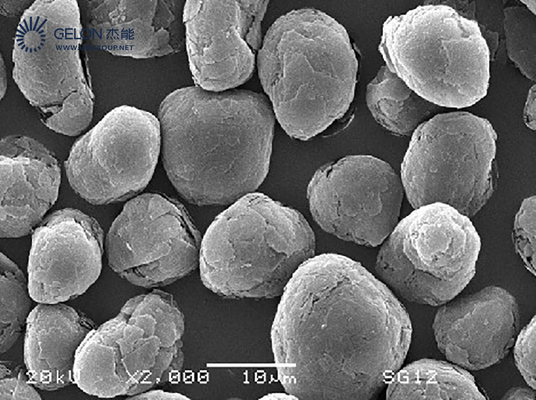
Test data: Particle morphology and elemental distribution of carbon-coated LFP-T2 (O, P, Fe). Carbon coating supports the 8.41×10⁻³ S/cm powder conductivity reported above.
Which Cathode Powder Fits Your Application
Choose carbon-coated LFP-T2
- University and institute electrochemistry experiments
- Electrode formula development needing documented conductivity
- Coin-cell and prismatic prototype testing
- Pilot-scale electrode and battery manufacturing within 500kgs/month
Consider another route
- Not for energy-density-first NMC or NCA power cells
- Not for cost-driven mass-market cells seeking the cheapest input
- Not for tonne-scale spot purchasing
- Not required where a carbon coating interferes with your electrode design
How to Choose in 5 Steps
- Set the priority. Pick LFP chemistry for cycle life and thermal stability; pick NMC/NCA for energy density.
- Decide on coating. Choose carbon-coated powder when conductivity and measured capacity utilization matter – LFP-T2 reaches 8.41×10⁻³ S/cm and 160.1mAh/g.
- Benchmark efficiency. Compare first-cycle efficiency against a stated standard: 98.3% versus 95% for LFP-T2.
- Check density and low-temperature data. Look at 1.43g/cm3 tap density, 2.18g/cm3 pressed density and 85%+ retention at -20C.
- Ask for batch documentation. Request XRD, SEM, PSD and full cycling reports, and confirm the 10-working-day lead time before ordering.
Frequently Asked Questions
Is carbon-coated LiFePO4 better than uncoated LiFePO4 for coin cells?
For coin cells where measured capacity and repeatability matter, carbon-coated LFP-T2 is the documented choice: 160.1mAh/g at 0.1C and 98.3% first-cycle efficiency against a 158mAh/g and 95% standard. Its 1.44% carbon coating delivers 8.41×10⁻³ S/cm conductivity. Uncoated LiFePO4 may still be preferred when the coating affects your electrode formulation.
Does carbon coating improve low-temperature capacity retention?
Carbon coating improves electronic contact between particles, which supports capacity delivery at low temperature. LFP-T2 retains 85%+ of capacity at -20C under 0.2C. Combined with 1.43g/cm3 tap density and moisture controlled to 330.3ppm, this makes the powder a practical candidate for cold-temperature LiFePO4 cell research and prototype testing.
Why is first-cycle efficiency higher with carbon-coated LFP?
The conductive carbon network reduces electron-transport losses during the first charge, so more lithium can be extracted reversibly. LFP-T2 reaches 98.3% first-cycle efficiency at 0.1C with 1.44% carbon content and 8.41×10⁻³ S/cm conductivity. Its 160.1mAh/g first capacity exceeds the 158mAh/g specification baseline measured under the same simulated cell test.
Which is better for pilot-scale manufacturing: coated or uncoated LFP?
For pilot-scale lines that need consistent electrode utilization, carbon-coated LFP-T2 offers traceable specifications: 2.18g/cm3 pressed density, 8.35m2/g surface area, 330.3ppm moisture and more than 2,000 cycles. Supply capacity is 500kgs/month with a 10-working-day lead time. Uncoated powder may suit processes where carbon content must be zero by design.
How do tap density and pressed density differ between coated and uncoated LFP?
Tap density measures how powder settles without pressure; pressed density measures compaction under load. LFP-T2 reaches 1.43g/cm3 tap density and 2.18g/cm3 pressed density, above its 1.2 and 2.10g/cm3 standards. Those two figures indicate how much active material can be loaded into a given electrode volume during manufacturing.
Where can I get LFP-T2 pricing and samples?
Pricing and minimum order quantity for LFP-T2 are quoted on request. Contact Gelon at gelon@libatteryequip.com to request a quotation, sample availability and the batch test reports. For full data, see the LFP-T2 product page and datasheet.
Still deciding? The answers on LFP-T2 efficiency, density and cycle life cover particle size, SSA, moisture and testing instruments in detail.
Need Help Choosing a Cathode Powder?
Ask Gelon for LFP-T2 specifications, batch reports and a quotation. Email gelon@libatteryequip.com.
Data source: Gelon in-house test reports (XRD, SEM, PSD and full electrochemical cycling). Last updated: 2026-11. Brand: Gelon | Model: LFP-T2 | Certification: CE | Place of origin: China. Related: LFP-T2 carbon-coated LiFePO4 cathode powder | LFP-T2 cathode powder FAQ.